

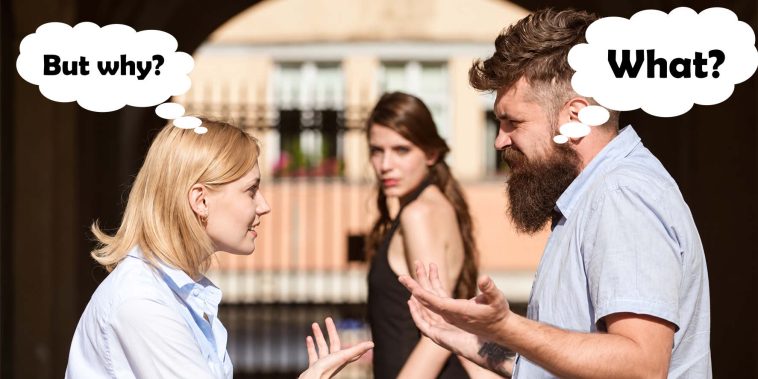
Have you ever caught your husband looking at another woman and immediately wondered, “Am I not attractive enough anymore?”
Perhaps you were enjoying a meal together, walking through a shopping mall, or simply spending time outside when you noticed his eyes following someone else. What might seem like a passing glance to him could leave you feeling uncomfortable, embarrassed, insecure, or even invisible.
If this has happened to you, it is natural to wonder what it means for your relationship.
But before you start questioning your appearance, your worth, or your place in your husband’s life, it is important to understand that there can be several reasons why someone notices other people, and not all of them indicate dissatisfaction with their marriage.
At the same time, your feelings deserve to be heard. There is a difference between briefly noticing someone attractive and repeatedly staring in a way that makes your partner feel disrespected.
Let’s explore six possible reasons behind this behaviour and what you can do about it.
1. He Is Attracted to Novelty
Human attention is naturally drawn to things that seem new, unfamiliar, or visually interesting. Some people notice unfamiliar faces or attractive people even when they are happy in their relationships.
This does not automatically mean they want to pursue someone else or that they no longer find their partner attractive.
However, there is an important distinction between noticing someone and repeatedly turning your attention towards them.
In a committed relationship, attraction to other people may occur, but how a person responds to that attraction matters. Respect involves recognizing your partner’s presence and being mindful of how your actions affect them.
What matters: A passing glance is different from behavior that repeatedly makes your partner feel ignored or disrespected.
2. He May Be Seeking Visual Excitement
For some people, looking at attractive people becomes an automatic habit. They may do it without thinking carefully about their surroundings or considering how their partner might interpret the behavior.
Others may consciously enjoy looking at people they find attractive, even when they have no intention of pursuing them.
Being in a relationship does not necessarily eliminate visual attraction. However, being committed to someone also means taking responsibility for your actions.
If your husband regularly looks at other women for longer than feels comfortable to you, it is reasonable to discuss what you consider respectful behavior within your relationship.
What matters: A habit is not an excuse to ignore your partner’s feelings. Awareness and willingness to change can make a difference.
3. He Enjoys the Fantasy or Temporary Excitement
Sometimes, a person’s attention is driven by curiosity, imagination, or the temporary excitement of something different.
This does not necessarily mean that they want to replace their partner or leave their marriage. A passing thought or moment of attraction cannot, by itself, reveal what someone truly feels about their relationship.
However, if a person constantly seeks excitement outside the relationship while neglecting emotional closeness at home, it may be worth exploring whether something in the relationship needs attention.
The goal is not to assume the worst based on a single glance. Instead, consider the broader pattern of behavior and the quality of your relationship.
What matters: Occasional attraction and consistently neglecting your partner are two different things.
4. He May Be Feeling Emotionally Disconnected
Emotional distance can develop in a marriage for many reasons, including unresolved disagreements, stress, poor communication, different expectations, or a lack of quality time together.
When partners feel disconnected, they may notice changes in how they interact with one another. In some relationships, seeking attention or stimulation elsewhere can become part of a larger pattern of disengagement.
However, looking at another woman alone does not prove that emotional intimacy is missing. It is important to look at other signs, such as whether your husband listens to you, makes time for you, shows affection, and takes an interest in your feelings.
If you feel emotionally distant from each other, an honest conversation about your connection may be more useful than focusing only on where his eyes go.
What matters: Understanding the overall emotional health of your marriage can help you address the real concern rather than relying on assumptions.
5. He May Enjoy External Validation
For some people, attention from others provides a temporary boost to their confidence or sense of attractiveness.
In certain situations, a person may look at someone else to see whether that person notices them in return. This behavior can sometimes be connected to insecurity, a desire for validation, or a need to feel admired. It’s about his ego that attraction.
But it is not possible to know someone’s motivation simply by observing where they look.
If you notice a broader pattern of flirtation, attention-seeking, or behavior designed to provoke jealousy, it may be worth discussing how that pattern affects trust in your relationship.
A healthy partnership should allow both people to feel valued without constantly competing for attention.
What matters: Your partner’s need for validation, if present, should not come at the expense of your emotional security.
6. He May Not Realize How Disrespectful It Feels to You
This is an important possibility to consider.
Your husband may see his behavior as harmless, while you experience it as embarrassing, hurtful, or disrespectful. Different people have different expectations about what is acceptable in a relationship.
Neither person can resolve the disagreement by simply insisting that their perspective is the only one that matters.
If you feel uncomfortable when your husband repeatedly stares at other women, explaining your experience can help him understand the impact of his actions.
For example, you might say:
“When we’re together and you repeatedly stare at other women, I feel uncomfortable and overlooked. I’m not asking you to pretend other people don’t exist. I want to feel respected when we’re spending time together.”
This communicates your feelings without attacking his character.
His response can also tell you something important about your relationship. Does he listen and try to understand? Does he dismiss your concerns? Is he willing to find a compromise that respects both of you?
What matters: You cannot control every thought or glance, but you can expect considerate behaviour and honest communication from your partner.
Does Your Husband Looking at Other Women Mean You’re Not Attractive Enough?
No. His behavior is not proof that you are unattractive or that you are somehow failing as a wife.
It is easy to compare yourself with another woman when you feel overlooked by your partner. You might start questioning your appearance, your age, your body, or whether you are still desirable to him.
But your worth is not determined by where your husband directs his attention.
People notice others for different reasons, and a glance alone cannot tell you whether your husband is satisfied with your marriage, attracted to you, or emotionally committed to you.
Instead of measuring yourself against every woman he notices, consider the relationship as a whole.
Does he show affection? Does he make an effort to spend time with you? Does he respect your boundaries? Can you talk openly about difficult feelings? Do you both feel valued?
These questions offer a more meaningful picture of your relationship than a single moment of visual attention.
The Difference Between Noticing Someone and Disrespecting Your Partner
It is helpful to distinguish between normal human attraction and behavior that undermines trust.
Briefly noticing someone attractive is not the same as repeatedly staring, making suggestive comments, openly comparing your partner with other women, or flirting in ways that violate agreed boundaries.
The context, frequency, and impact of the behavior matter.
If you feel hurt, you do not have to dismiss your feelings simply because your partner calls the behavior harmless. Equally, it is worth avoiding conclusions about his intentions without discussing what happened.
A healthy relationship makes room for both perspectives: one partner can explain their intentions, while the other can explain the emotional impact.
Respect develops when both people are willing to listen and take each other seriously.
How to Handle It When Your Husband Looks at Other Women
If this behavior is affecting your confidence or creating arguments, consider the following steps.
1. Identify What Actually Hurts You
Is it the glance itself, the fact that it happens repeatedly, the embarrassment you feel in public, or the sense that your husband is not paying attention to you?
Understanding the specific concern can help you explain it clearly.
2. Talk When You Are Both Calm
Avoid starting the conversation in the middle of an argument if you can help it. Choose a private moment when you can both speak honestly without feeling attacked.
Describe what you noticed, how it made you feel, and what you would like to change.
3. Agree on Reasonable Boundaries
Every couple has different expectations about looking, flirting, socializing, and interacting with other people.
Discuss what respect looks like to both of you. The aim is not to control every movement or thought, but to establish mutually acceptable boundaries.
4. Pay Attention to His Response
A partner does not have to agree with every interpretation to show empathy. What matters is whether he is willing to listen, understand your perspective, and discuss a constructive way forward.
Repeated dismissal, humiliation, or deliberate attempts to make you jealous deserve attention beyond the original incident.
5. Rebuild Connection Together
If the behavior part of a larger pattern of emotional distance, consider making time for meaningful conversations, shared activities, affection, and quality time.
If you cannot discuss the issue without recurring conflict, couples counseling may help you understand each other’s needs and develop healthier ways to communicate.
6. Protect Your Self-Respect
You do not have to compete with every woman your husband encounters to feel beautiful, valued, or secure.
Take care of your own emotional well-being, maintain meaningful relationships outside your marriage, and remember that your value does not depend entirely on your partner’s attention.
The Real Question Is Not Just Why He Looks
It is understandable to want a clear explanation for your husband’s behavior. However, there may not be one simple answer.
He might be noticing someone without thinking much about it. He might have a habit he has not recognized. There could be a difference in your expectations about respectful behavior. Or the issue might be connected to a wider pattern of disconnection or unmet needs.
You cannot determine which explanation is correct without considering the circumstances and talking openly.
What you can pay attention to is how the two of you handle the issue once it has been brought into the open.
Can you express your feelings without being mocked? Can he explain his perspective without dismissing yours? Are both of you willing to work towards a relationship in which you feel respected and emotionally secure?
These questions can help you move beyond comparison and towards a clearer understanding of your marriage.
Final Thoughts
If your husband looks at other women when you are standing beside him, you do not need to immediately blame yourself or assume that your marriage is in trouble.
A glance does not define a relationship. But repeated behavior that leaves you feeling humiliated, ignored, or insecure should not be dismissed either.
You deserve a relationship in which both partners can communicate honestly, respect each other’s boundaries, and take each other’s feelings seriously.
You do not have to compete with other women to prove your worth. The goal is not to control every glance. It is to build a relationship where attraction, trust, emotional connection, and mutual respect can coexist.
Sometimes, the most important question is not simply, “Why is he looking at her?” but, “What happens when I tell him how it makes me feel?”
The answer can help you understand what needs attention and what steps may help you move forward with greater confidence and clarity.

