

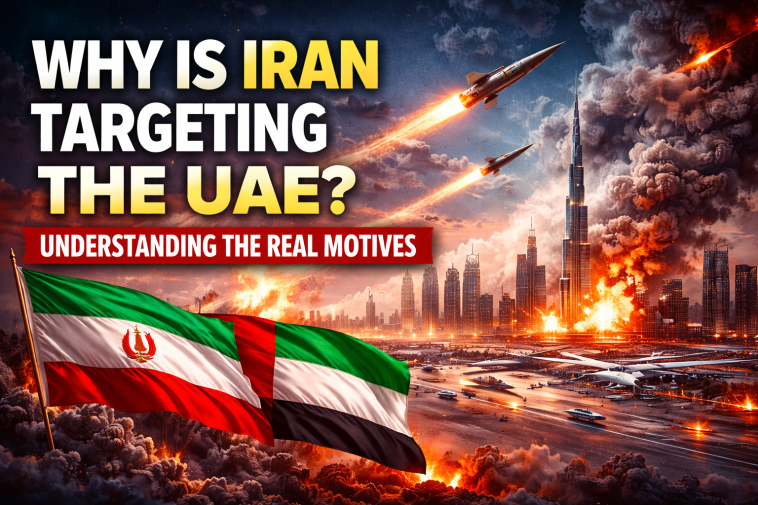
Iran isn’t attacking the UAE out of direct hostility toward the country itself.
The main reasons are strategic and tied to the US–Israel–Iran war unfolding right now:
1. UAE Hosts U.S. Military Assets
Iran’s official justification for striking UAE territory is that U.S. military bases and assets in the Gulf region – including in the UAE – are part of the broader conflict between Tehran and Washington/Israel.
Iran’s leadership says it targets U.S. facilities wherever they are in the Gulf, not the host nations’ sovereignty.
In public Iranian statements, Tehran argues that it’s striking U.S. bases and supply lines used to attack Iran, and those happen to be on UAE soil.
2. Retaliation for US & Israeli Strikes
The current escalation began when U.S. and Israeli forces conducted major air strikes on Iranian territory, including reports of high-level Iranian leadership casualties.
Iran’s missile and drone campaign is a retaliatory wave that includes hits on:
- Israel
- U.S. bases
- Gulf host nations including UAE
This is not a separate Iran–UAE war – it’s part of Tehran’s broader response strategy.
3. Pressure Strategy
By hitting UAE infrastructure – airports, airspace, and strategic sites – Iran is trying to create leverage and economic pressure on:
- Gulf governments
- Western allies
- International trade routes
Attacking globally connected hubs (like Dubai airports) causes disruption far beyond borders, putting pressure on allies of the U.S. to reconsider their support or involvement.
4. UAE’s Diplomatic Posture
Before the conflict escalated:
- UAE normalized ties with Israel through the Abraham Accords.
- Iran publicly criticized that agreement, calling it a “betrayal” of regional sentiments.
This historic diplomatic shift arguably made the UAE part of the broader geopolitical chessboard – not as an enemy, but as a partner of Iran’s adversaries.
5. Symbolic Expansion
Iran’s leadership might be attempting to send a message far beyond the battlefield:
“If our territory is attacked from here or with support from here, we can respond across the region.”
That’s a strategic posture – not an indication of deep geopolitical hatred between Iran and the UAE per se.
What Experts Are Saying
Regional analysts describe this as:
- Not a direct attack on the UAE’s sovereignty
- Part of Iran’s counter-offensive against U.S./Israeli military presence
Which explains why:
- Gulf states quickly condemned the strikes
- They emphasize Iran’s actions violate international law, not legitimate self-defense against adversaries’ bases.
This aligns with the fact that global powers and Gulf leaders still want to avoid a deeper regional war – despite Iran’s expanded targeting.
Summary
Iran isn’t targeting the UAE because of historic rivalry or geopolitical antagonism between Tehran and Abu Dhabi.
The attacks are:
- Retaliatory — tied to U.S. and Israeli operations.
- Strategic — aiming at U.S. military presence and political leverage.
- Symbolic — warning Gulf nations about alliances with Western powers.
That’s why even experts who follow Middle East policy find this angle harder to explain – it’s an extension of a bigger conflict, not a bilateral Iran–UAE war.
Continue Reading:
- Brand Dubai Launches ‘Ramadan Recipes Guide’ Showcasing Dubai’s Rich Culinary Diversity
- What Happens If UAE Freezes Your Bank Account
- Strait of Hormuz Crisis: Why It Matters to the World

