
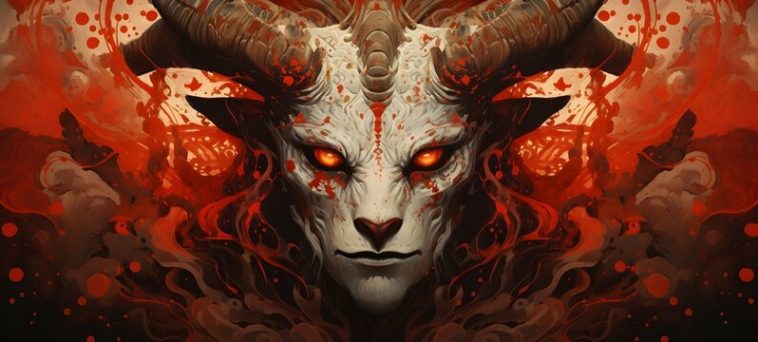
The Emirates shine in glass and steel.
But beneath the skyline, beyond the luxury of Dubai, past the highways of Abu Dhabi, through the mangroves of Umm Al Quwain and the mountains of Ras Al Khaimah — there is an older world.
A world of whispers.
Before oil.
Before towers.
Before borders.
There was desert. And sea. And silence.
And in that silence, something moved.
This is not fantasy imported from the West. These are not borrowed myths. These are stories born in Gulf wind, shaped by pearl divers, shepherds, fishermen, and Bedouins who read the land like scripture.
These are the monsters and mythical creatures of the Emirates.
And they were never meant to be comfortable.
Ifrit – The Fire That Walks in Anger
Imagine standing alone in the Empty Quarter at night.
No city lights.
No signal.
No sound but wind brushing across dunes like a distant breath.
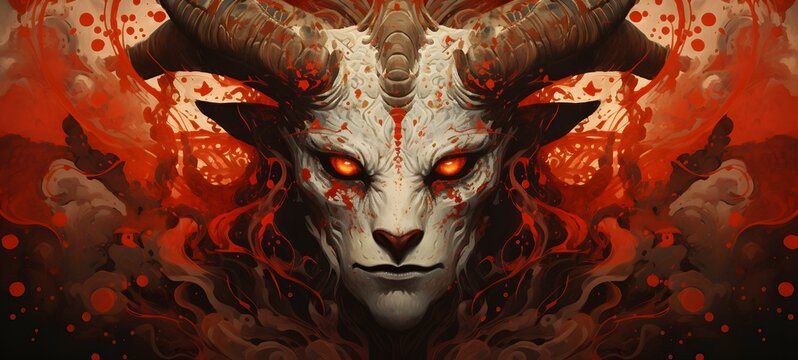
Then — far away — you see a flame.
Not a campfire. Not lightning. A moving flame. Tall. Slow. Intentional.
The Ifrit is not merely a jinn. In Arabian and Emirati lore, it is a powerful spirit of smokeless fire — often described as enormous, winged, blazing from within. Its eyes burn like embers buried in ash.
But what makes the Ifrit terrifying is not its appearance.
It is its memory.
The Ifrit does not forget insult. It does not forgive arrogance. Old stories warn that those who mocked the unseen or entered forbidden places without respect would encounter it — not immediately, but eventually.
A string of misfortune.
A sudden illness.
A fire that begins without cause.
Among elders, there was always this rule:
Do not boast in the desert.
Do not challenge what you cannot see.
Because the desert listens.
And fire answers.
Dandan – The Devourer of Ships
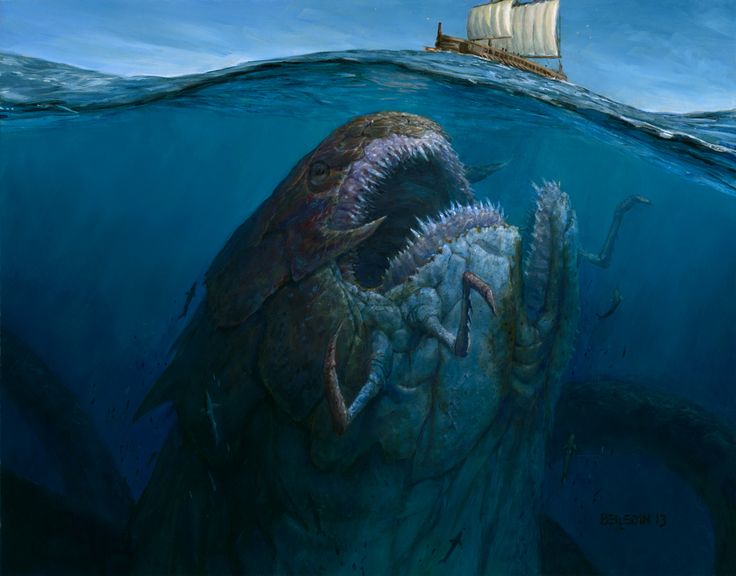
Before the Emirates became a hub of global trade, the Gulf was ruled by wooden dhows and pearl divers.
And the sea was not friendly.
The Dandan is described as a monstrous sea creature so vast that sailors mistook its back for an island. Some say its mouth could swallow entire ships. Others describe it as a shadow beneath the water — long, coiling, patient.
Picture a pearl diver in the 1800s.
He ties a rope around his waist. Takes a stone to descend faster. Holds his breath. Drops into the dark green waters of the Gulf.
Below him: silence. Pressure. Cold.
Then something shifts in the deep.
Not a fish. Not a current.
Something alive. And aware.
The Dandan embodies every fear the sea ever carried — the unpredictability, the sudden storms, the disappearances never explained.
Even today, when a fishing boat returns late and radios fall silent, the old stories stir.
The Gulf gives.
But it also takes.
Jinn – The Unseen Residents of Our World
In the Emirates, belief in jinn is not myth alone. It is woven into faith and culture.
They are said to be created from smokeless fire. They live in ruins, deserts, empty places, and sometimes among us.
There are stories of construction sites where tools move on their own. Of abandoned villas where lights flicker though electricity is cut. Of desert camps where footsteps circle the tent but no one stands outside.
Jinn can shapeshift.
They may appear as animals — especially black dogs or snakes. They may appear as strangers on an empty road. Sometimes, they whisper.
If you grew up in the UAE, you may have heard:
Say Bismillah before pouring hot water outside.
Do not whistle at night.
Do not wander alone in abandoned places.
Not superstition.
Precaution.
Because the most disturbing thing about jinn is this:
They are not bound by our rules.
And they have their own societies.
Hinn – Spirits of the Desert Wind
Drive between emirates during a sudden sandstorm.
One moment the sky is clear.
The next — the world turns orange.
Visibility disappears. The horizon vanishes. The air feels thick, alive.
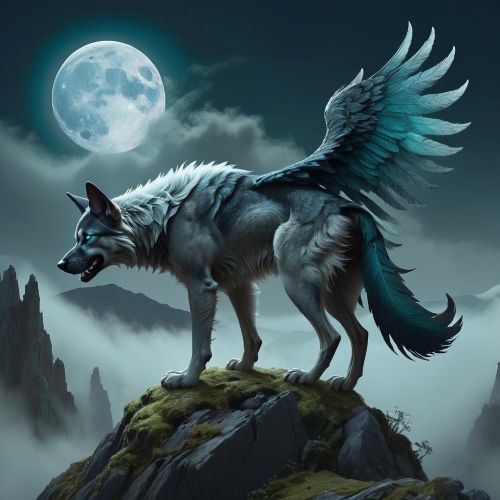
The Hinn are ancient spirits associated with wind and wilderness. Some traditions place them before jinn in the order of creation.
They are not visible in form — but they manifest in force.
The sudden gust that slams your car sideways.
The sand that stings your skin like needles.
The howl in the dunes that sounds almost like a voice.
The Hinn are the desert itself expressing will.
And the desert has never belonged to us.
We only pass through it.
Marid – The Proud Giant of the Deep Waters
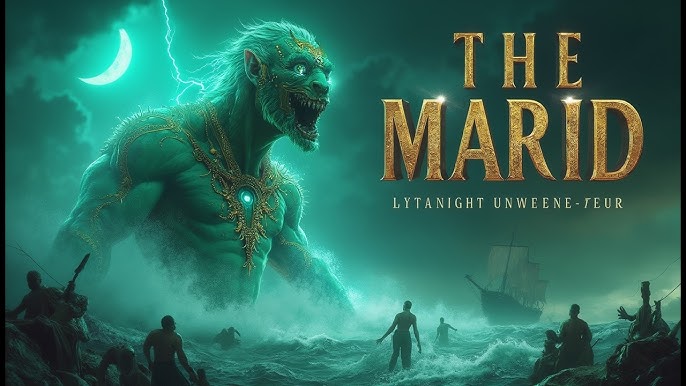
If the Ifrit burns with rage, the Marid stands with pride.
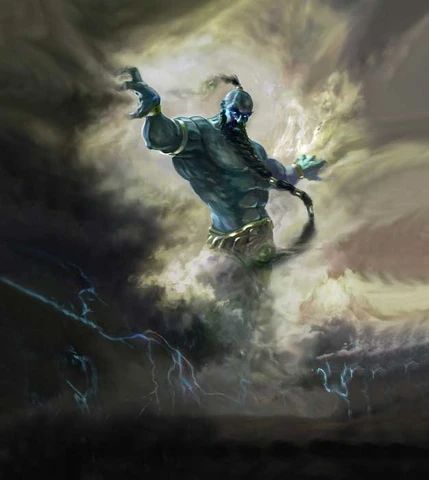
These powerful water jinn are said to inhabit the depths of seas and oceans. Massive. Blue. Commanding storms with a gesture.
Unlike lesser spirits, Marid are notoriously difficult to control. Stories speak of fishermen who made desperate bargains — asking for wealth, protection, or safe passage.
But wishes from a Marid are never clean.
A wish for wealth may bring fortune — and isolation.
A wish for protection may cost loyalty.
A wish for love may twist into obsession.
The Marid represents power without compassion.
In a land once dependent on the sea, that fear was very real.
Nasnas – The Half-Formed Horror
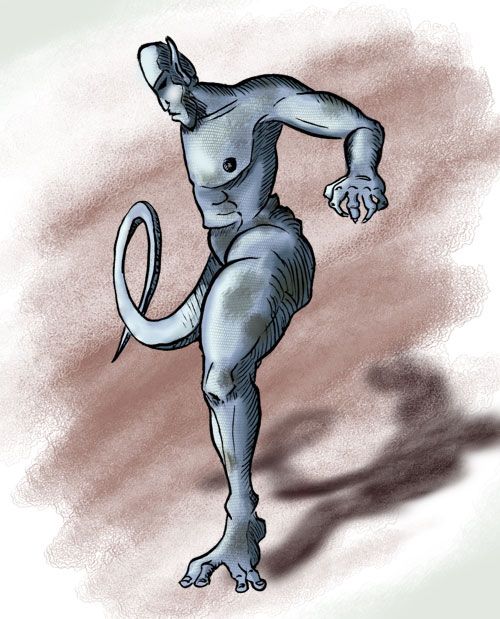
Among the strangest of Arabian creatures is the Nasnas.
Described as half a human — one arm, one leg, half a face — it moves by hopping across the desert.
Think about that.
A vast, empty desert night. No lights. No civilization. Just dunes rolling endlessly.
And somewhere out there — something is hopping.
Closer.
The Nasnas is said to attack travelers, or lure them into isolation. Some interpretations say it represents spiritual incompleteness — a being cut off from balance and humanity.
But folklore rarely creates something this grotesque without reason.
The desert punishes imbalance.
And the Nasnas is imbalance made flesh.
Si’lah – The Beautiful Trap

Not all horror looks monstrous.
The Si’lah appears as a stunning woman wandering alone in the desert. Lost. Vulnerable. In need of help.
Hospitality is sacred in Emirati culture. To refuse aid is unthinkable.
And that is what makes her terrifying.
Because those who approach her often disappear.
The Si’lah is a shapeshifter — a being that uses beauty as bait. She reflects a deep warning within Gulf culture:
Not every cry for help is safe.
Not every face is what it seems.
In a land built on trust and honor, deception becomes the sharpest blade.
Ghoul – The Devourer of the Dead
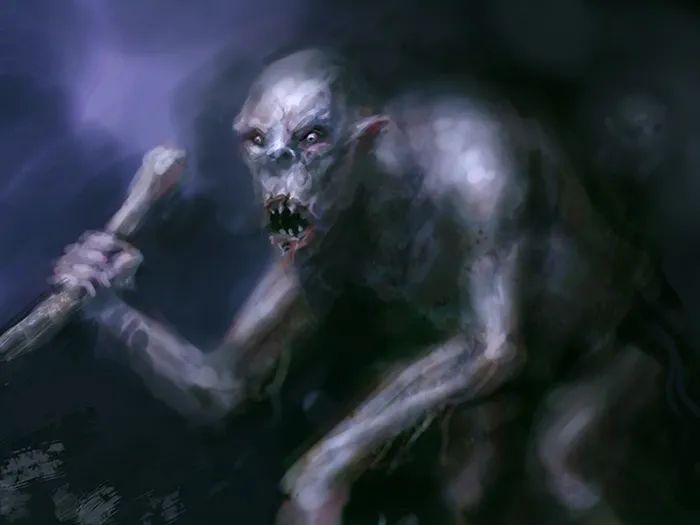
Long before modern cemeteries, burials were simple. Desert graves marked by stones.
And something was said to roam them.
The Ghoul feeds on the dead. But it does not stop there. It lures the living by mimicking voices — a lost traveler calling for help, a familiar voice in the dark.
It waits until you leave the path.
Then it hunts.
The ghoul is primal fear — decay, hunger, abandonment. It thrives in isolation.
And the desert offers isolation in abundance.
Shaytan – The Whisper in the Mind
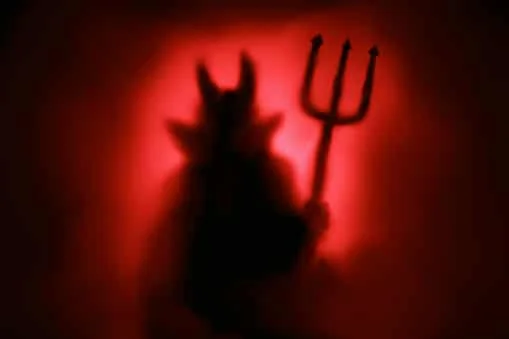
There are creatures that stalk the desert.
There are beasts that rise from the sea.
But Shaytan does not need wind, water, or flame.
He stands closer than your own shadow.
In Islamic tradition, Shaytan was not created evil. He was elevated. Among the worshippers. Among the devout. Until pride burned inside him.
And pride turned to defiance.
He refused the command of Allah. He refused to bow. And when cast down, he did not ask for forgiveness.
He asked for time.
Time to mislead you.
Time to corrupt you.
Time to sit inside your life and slowly bend it.
That is what makes him terrifying.
Shaytan does not appear with horns and chains. That is fantasy.
He approaches when you are alone.
Not in the desert.
Not in a graveyard.
In your room.
In your car.
In your thoughts.
He does not shout.
He suggests.
“Skip it.”
“Later.”
“It’s not that bad.”
“No one is watching.”
“Just once.”
And he waits.
He studies your weaknesses — anger, ego, desire, jealousy. He knows where you are tired. He knows where you are insecure. He knows where you are proud.
He does not need to drag you.
He only needs to nudge you.
In Emirati homes, elders would warn children not only about jinn in empty places — but about whispers in the heart.
Because Shaytan’s battlefield is not the desert.
It is the chest.
And the most frightening part?
You will think the thought is yours.
You will defend it.
You will justify it.
Until one day you look back and realize — the path changed slowly. Quietly. Without noise.
There was no monster under the bed.
The monster was patient.
And he was inside your decisions.
Bahamut – The Cosmic Beast Beneath Existence
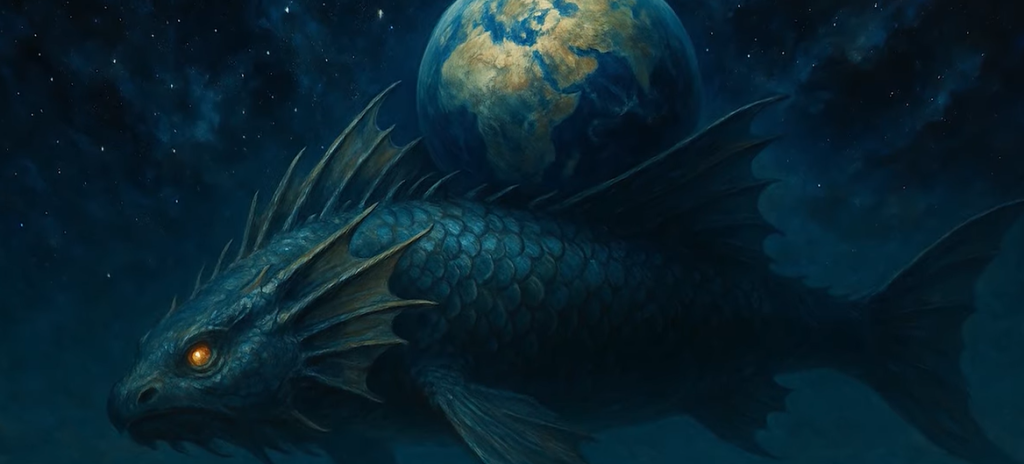
Ancient cosmology speaks of Bahamut — a colossal sea creature so vast that the world rests upon it.
Layer upon layer of existence — ocean, beast, earth, sky.
Imagine that scale.
The idea that beneath everything we know — beneath the skyscrapers, beneath the desert, beneath the tectonic plates — something ancient supports it all.
It is not horror of teeth or claws.
It is existential awe.
The fear that what we stand on is not as solid as we think.
Why These Stories Still Live in the UAE
The Emirates are modern, ambitious, future-facing.
But culture does not disappear with progress.
These legends were born from real fears:
- The unpredictability of the sea
- The danger of desert isolation
- The reality of spiritual belief
- The fragility of human life in harsh environments
They are psychological maps of survival.
And when the wind howls through the dunes at night…
When the Gulf grows still before a storm…
When you feel watched in an empty stretch of sand…
You understand something simple:
The Emirates is all about luxury and flaunting cars in day.
But at night, The desert does not sleep, It only watches.
Also Read: