
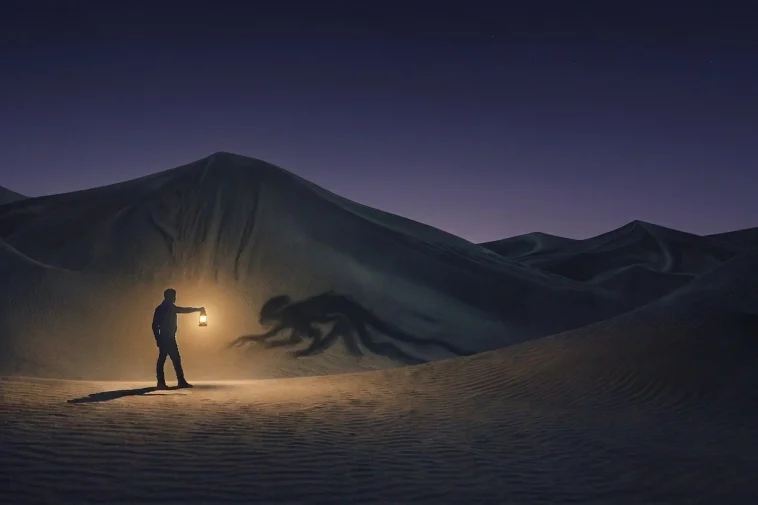
The Desert Does Not Forgive — It Teaches
There is a certain silence in the desert that feels unnatural. Not peaceful, not calm — but watchful. A silence that presses against the ears until the mind begins to fill it with something else.
Long before cities like Dubai and Abu Dhabi rose from the sands, the desert was not just a landscape. It was an environment that tested human limits — physically, mentally, and spiritually. In such conditions, survival demanded more than strength. It demanded meaning.
And meaning is often born from fear.
This is where stories begin.
When the Mind Faces the Unknown
Imagine walking alone across endless dunes. The horizon does not change. The sun burns without mercy during the day, and at night, darkness falls with a depth that feels almost alive.
In such isolation, the human mind does something remarkable — it begins to create presence.
What is not seen becomes imagined.
What is not understood becomes explained.
This is where beings like the Jinn emerge — not merely as supernatural entities, but as psychological responses to an overwhelming environment.
The desert strips away distractions. What remains is the raw human mind, forced to confront itself.
Fear as a Survival Tool
In modern life, fear is often seen as something to overcome. But in ancient desert cultures, fear was essential.
Stories of creatures lurking beyond the dunes were not random inventions. They served a purpose:
- To warn travelers against wandering at night
- To discourage entering unknown territories
- To explain sudden disappearances or deaths
A tale of a Ghoul was not just a story — it was a boundary. A way of saying: do not go there.
In a land where a single mistake could cost a life, myths became a form of protection.
The Illusion of the Desert
The desert is not static. It deceives.
Heat creates mirages — water where there is none.
Wind reshapes dunes — paths vanish without warning.
Sound travels strangely — whispers seem to come from nowhere.
To someone without scientific understanding, these were not natural phenomena. They were signs.
A shadow moving across dunes could be interpreted as a presence. A distant flicker of light could be mistaken for something watching.
Over time, these repeated experiences formed patterns. Patterns became beliefs. Beliefs became legends.
Loneliness and the Birth of the Unseen
Human beings are not designed for prolonged isolation. The desert, however, demands it.
Caravans would travel for days, sometimes weeks, with minimal human interaction beyond their small group. In such conditions, the mind begins to compensate.
It creates voices.
It assigns meaning to randomness.
It transforms silence into something that feels inhabited.
This is where the idea of unseen beings — like Jinn — becomes deeply compelling. Not because they were proven, but because they were felt.
The desert does not need to show something for you to believe it is there.
Fire, Darkness, and the Language of Myth
Many Arabian legends describe supernatural beings as creatures of fire. This is not accidental.
Fire, in the desert, is both life and danger:
- It provides warmth in freezing nights
- It offers light in absolute darkness
- It also destroys without warning
To describe beings as made of fire is to give them the same dual nature — helpful, yet dangerous. Visible, yet uncontrollable.
Myths, in this sense, are not random fantasies. They are symbolic languages shaped by environment.
The Thin Line Between Belief and Interpretation
It is important to understand that not all stories were meant to be taken literally. Many existed in a space between belief and interpretation.
Religious teachings, cultural storytelling, and lived experiences often blended together. The concept of Jinn, for example, exists within Islamic tradition, but the way people interpreted encounters varied widely.
Some saw them as spiritual beings.
Others as explanations for the unexplainable.
The desert allowed both interpretations to coexist without conflict.
Stories That Outlived the Sand
Today, the UAE is a place of skyscrapers, highways, and artificial islands. The desert still exists, but it no longer defines daily survival.
Yet the stories remain.
Why?
Because they were never just about creatures. They were about human experience:
- Fear of the unknown
- The need for control in uncontrollable environments
- The search for meaning in isolation
These are not ancient problems. They are timeless ones.
The Real Monsters Were Never the Creatures
It is easy to dismiss these legends as superstition. But doing so misses their essence.
The true subject of these stories was never the creature itself. It was the human response to uncertainty.
The desert did not create monsters.
It revealed the mind’s need to create them.
And even today, in a world filled with answers, that need has not disappeared.
It has only changed its form.
Also Read:
- Monsters and Mythical Creatures of the Emirates (UAE)
- Hidden Costs of Living in UAE No One Talks About